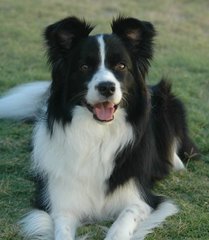
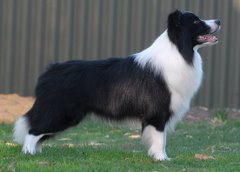
So this is the final chapter in my Greg Derrett Seminar series. It will finish off the Friday night seminar that concluded with Weaving and weave training and go into a run down of what we did at the final seminar on Saturday morning. The weave poles had been set up as usual. First let me post a picture or two of what our weave poles look like.


They are all made of flexible light weight pvc piping and are either stick in the ground individual poles or as in the second picture with the Border Collie they are slipped onto a metal base that is secured to the ground via tent pegs. As you can see they do bend quite substantially. So Greg had us set up twelve of our weave poles and then just asked those with the working spots to run their dogs through calling out after each one whether they single strided the whole way, double footed them or had inconsistent style (ie they flicked between both ways of doing them). The majority of the dogs had an inconsistent stride pattern. Greg said that he strives to get a consistent pattern with his weaving, he doesn’t mind which stride pattern the dog chooses to do more comfortably (however he said the single stride pattern was known to be the quickest) however he does work to make sure the dog consistently sticks to that pattern whatever it ends up doing. Greg trains his weaves using weave-a-matics and V poles and they will be the last piece of equipment that he trains a dog to do. So he explained the structure and design of the weave-a-matics for the benefit of our equipment makes in the audience, I kind of got the picture of what they should look like but I leave it up to the engineering types to make a set. Hopefully our club will have a set in the not too distance future. So Greg has the weave-a-matics out at home and when he first puts a dog on them they are of course lying nearly flat on the ground. See pictures below for examples that I got off the net.


So anyway as you can see the weaves are on a slant and they can slant all the way down to the ground (or they should be able to put it that way). He simply starts off getting the dog to run through them with him running along side with food or a toy on either side, with another person holding as he goes up the other end with toy and gets the dog to release and run through the poles to him. At this time he watches very carefully to ensure the dog is using even striding patterned footwork through all the poles. As soon as he can he brings the poles up by a couple of inches each time, always reinforcing highly and watching to ensure the stride pattern remains consistent, The second the dog starts to do something different with its footwork he lowers it back down an inch and does more repetitions at the lower position before trying to raise it up again. Greg did say that the aim was to get those poles into an upright position as soon as possible. When queried on head positions in weave poles Greg acknowledged that lower head carriage is always going to be faster than head held high (however he also stated that there are some dogs who are still very competitive despite their head position being higher than others). He didn’t have too many suggestions for how you could change this or even if you should try, again weaves being one of those obstacles where you simply should work with what the dog is physically capable of giving you and aim to make of that the best you possibly can. One suggestion was to use very, very short weave poles (ie half the height of the dog) so that the dog has to duck its head down to actually weave the poles. Greg wasn’t too sure how effective this works as he has only seen it done once and it appeared to work for that dog at that session he saw. He also noted that the type of weave poles we used meant that the dogs did not have to weave as much because he observed many dogs just pushing them out of the way because of the flex in them. This in turn caused some fast dogs to get hung up in the poles because they hit them so fast. His advice? Train on solid poles only, that way the dogs get used to not being able to push through them using their bodies as solid poles have no give in them. That way they actually weave with their whole bodies and learn not to touch the weave poles at all or rather just brush by them lightly. He has a drill to train his entries shown in the below diagram;

He got us to show how well our dogs were proofed on weaving by having us run halfway up parallel and then stop whilst they kept weaving. We then veered off to the left about 10 meters as our dogs had to finish the poles. He also go us to run with our dogs halfway up and then quickly flick around and run backwards on the same line as our dogs continued in the weaves, there were a few more I think that I can't quite recall (didn't get to write them down as was running Raven). He got us to send our dogs into the poles at a 90 degree angle over a jump, he then got us to run with our dogs doing the same thing. Then the final challenge was the 90 degree entry from over a jump with us rear crossing very closely. That one caught Raven out! I rear cross on her weavers often however never at that angle I must admit.That concludes his talk on weaving, the most important to points is to get fluency on the stride pattern and to bring those poles up as soon as you can. Then once you have that start proofing them!
Moving on to Saturday’s workshop, this again was done with Novice/Excellent level dogs and was the final workshop for the weekend. Jumping was first up on the agenda. First thing Greg did was set up a 4 jump grid that meant the dogs touched the ground twice between each jump. He wanted to have a look at the style of jumping on the dogs. There were one or two who needed work on judging their take off points but by and large he was generally satisfied that our dogs were good jumpers and had a nice style. He brought us back to the whiteboard. First thing he told us is that he is not in anyway a full expert on jumping and that everything he knows about it was gleaned from other more knowledgeable sources than himself. However he did say one thing he has always taught before starting any jumping is hind end awareness and weight shifting. This is where teaching your dog to go backwards and other basic tricks where they have to use their back feet is obviously one way of raising their awareness. He uses tugging as part of his method for teaching the dog to shift its weight back. He does many of the Susan Salo exercises as well as jump chute work but those things have never been a major part of any of his training although he has used them for many students who dogs with jumping issues. Greg believe that the double box work has helped to teach his dogs many of their jumping style skills and that by working double box regularly from the moment they are old enough to start jump training actually gets them well trained in jumping technique. He quickly drew up on the board some of the Susan Salo exercises which involve having bars on low to start with and placing them in a ‘W’shape using four bars with a bar at the bottom, so everything is very close together. There was also the use of a ‘V’ shape running from the uprights on one bar jump to help teach take off points. All these exercises I have seen and done before when one of our club members came back from a Greg Derrett/Susan Garrett Seminar in Queensland a few years ago. If anyone would like me to post the diagrams let me know and I’ll do so. Greg maintains that dogs (particularly Border Collie shaped/type dogs) jump better at the higher heights than the lower. He believes that Border Collies especially need to have the higher jumps to encourage that rounding of the jumping arc as they are so prone to jumping flat naturally. He said if he was competing here (where most BCs are in the 500 height class) he would be competing in the 600 height class. This was food for thought for quite a number of handlers.
Of course we brought the issue up of the bars being knocked what does he do? Greg ignores them. For two main reasons 1) He never wants that dog to slow down for any reason, it’s all about speed and if he starts trying to correct knocked bars this dog may start to slow down 2) He doesn’t believe you can ever really clearly, consistently punish for dropped bars. Out of the whole weekend or four days of seminars this is where I had the biggest difference of opinion with Greg. I knew it was a difference of opinion and knew if I said anything we’d probably just end up wasting a lot of time debating something that he is never going to change his mind on and I was never going to change my mind on. I must admit it was hard for me to fathom never ever letting a dog know that knocking a bar is *not* what I want. I should be clear here, when Greg says ‘punish’ for knocked bars I know that he would consider what I do to be a punishment. I stop running, I tell Raven to lie down (usually about three times), and I replace the bar and leave the course in a trial situation. In training I’ll stop running, tell her to lie down, replace the bar. Sometimes I will start again, sometimes I will continue on and sometimes I will leave and miss our turn. If I don’t do this and start ignoring her knocking bars she will start knocking bars more and more. Greg would probably say this isn’t working since she still drops bars. Yes she does, but she is dropping bars a hell of a lot *less* than she used to! I think to truly understand the importance of teaching your very fast, high drive, completely intense BC, to respect bars and not to touch them you have to actually own and handle a dog who really couldn’t care less if bars stay up or not (and yes I know this attitude was cultivated by when I started jumping her at around 12 months I didn’t take *any* notice of bars dropping). There are not many dogs like this, most of the ones I have seen or trained or instructed have a more careful jumping style or they just don’t have that flat out speed or they just don’t like the feel of hitting the bar. I don’t agree with any kind of negative punishment of knocked bars (ie electrifying bars, fishing line, threatening with dropped bars etc) however I do believe in the removal of the reward (for Raven it is getting to do the course or getting her treats if we are doing single bar work) if a bar is dropped, and I do believe in letting the dog think about why the fun stopped. Yes I know bars drop 9 times out of 10 due to handler error, and the majority of handlers and dogs will ignore their bars dropped in trials and training because the dog does not have a jumping issue. I will ignore most of Cypher’s dropped bars because I know he doesn’t have the same attitude and that he is a fairly clean jumper most of the time plus I need his speed up a bit more. However when you have a dog who purely knocks bars because she is just rushing her jumping too much (and this is only discerned after much soul searching) then you need to do something about it. I know I will never have Raven’s bar issue cured, there has been too many massive gaps in her foundation jump work (as in there wasn’t any…think I just went “Cool she goes fast and can jump over a bar….let’s trial!”) and her pure obsession with going as fast as she possibly can which often means leaving *no* room between her and the bar but I know I can make it better and that is what I work on. Now when we trial, more often that not I will see her try really hard (as in she will work hard to put that extra stride in to round her arc etc) to keep bars up and that is all I ask of her. Sure bars still come down and we still leave the ring but it is certainly not as often as it used to be. So coming back to Greg and his jump training philosophy I agreed with all the drills he recommended as I already do many of them. His approach to what to do with bars dropping will indeed work for most dogs, however having owned such a chronic bar issue dog from here on in I will never disregard a knocked bar. I will always stop what we are doing and put the bar up, no matter which dog I own or train in the future. I won’t have to say anything to them, they won’t have to lie down or anything I’ll just stop, pick up the bar and replace it and the game continues. This is not punishment in my book; it’s just letting the dog know that bar knocking has a consequence, if just for a few seconds.
Moving on….Greg then set up some great jumping drills that he works on at home. Unfortunately when I asked his permission to write all this up on the blog he asked me to leave out the drills from Saturday morning as they are quite new and they will indeed be on his next DVD due out soon apparently. So if you want to know what they are you may have to catch up with me at training one night when I set it up to work on or when I’m travelling around Australia to trial! Or it may be quicker to just wait for the DVD!
We then set up a jumping course that was brought to the seminar by an auditor and we discussed what way we would handle it if we were following Greg’s system for handling. It came back to the decision making again and this is something that makes perfect logical sense when it is broken down into tiny steps however to put it all together and apply to a full size course is another matter. Again we returned to the points system when looking at how to handle something. 1)Where are you going to? 2) What is the distance to the next obstacle? And 3) Where are you coming from? So when looking at a handling choice, such as in the two diagrams below (starting at #4):


There are decisions to be made about which way to take the dog over #5 and over #6. You can see the dog’s path shown by a red line in one diagram and a blue line in the other. We would have to consider where are coming from in terms of #4 to #5. If you ran it with your dog on your right the quickest line without any deviation for the dog would be for the dog to turn left over #5. So that is 1 point for left. We then look at the distance, clearly the shortest distance for the dog to take from #4 to #5 would be for the dog to be heading over #4 closest to the right upright and then wrap around to the right over #5. So that is 1 point for right. So then you go to your last handling consideration and that is looking at where you are going to according to where the last obstacle on the course is (not just where the next obstacle is). You can clearly see that the blue line from #6 to #7 places the dog on the best possible line for the run home, with that in mind looking at the decision you need to make about which way to turn the dog on #5 (remember we are at 1 point for left and 1 point for right so far) having the dog wrap LEFT around the #5 upright with you front crossing close to the upright so your dog is on your left as you head to #6 where you can do another tight front cross on the upright to wrap your dog to the right of #6 then adds 1 point to the wrapping your dog to the LEFT over #5 in the decision making. This makes it 1 point for turning your dog right based on distance but based on where you are coming from and where you are going to you get 2 points for wrapping your dog to the left. This then makes the decision about what to do over #6 no longer a decision. See diagram below with dog’s path in black.

Now this is just two obstacles on a very short sequence where we need to make a decision about which way to turn the dog. Greg’s points system is a logical way of working out the solution. It is something that I will try and use every course I walk from now on. Unfortunately it is still at the conscious steps phase for most of us, that is; we all need to literally step it through with each question and we don’t always get a clear cut answer straight away, or put it this way we don’t *see* the clear cut answer straight away. It can take us quite a while to work it through on something fairly simple like the above examples. We need to get far more proficient and natural at recognising very quickly the best path for the dog to take. As Greg said, he’s been playing this game since he was 12 years old so by now this sort of course decision making is as natural as breathing to him. The rest of us shall just have to work damn hard to get there! Another added advantage of using this system is you quickly identify what skills you need to train for or improve on. Sometimes handlers do not take the glaringly obvious quicker more efficient line for the simple reason of they don’t feel confident enough in their skills to ask this of the dog, they know their dog is not so good at it or they know they themselves are not so good at something (270s, pull throughs, rear crosses, front crosses, post turns, serpentine handling, lead out pivots etc etc) and so they end up taking a longer route, which may of course allow them to go clear, gain a qualification card and even move up a class. I have certainly been guilty of this when trying to gain titles (yet I do note what skills we need to work on and I never settle for baby sitter handling!). So this is one of the drawbacks of not using the win out system in our agility, it does allow handlers to move up even if they don’t have some of those skills at even a very primary level (ie barely proficient). This will in turn lead to some mediocre performing dogs attaining the top levels, it is inevitable. At the end of the day I don’t really have a problem with this as I know Australia will always have those handlers who will strive for perfection in every skill they need for agility and as long there are those I think the ‘must go clear’ system works very well for us.
I have one more additional diagram to include that after reading back through my GD posts I realised I have omitted in my Chapter 3 on front cross drills. I included this diagram here;
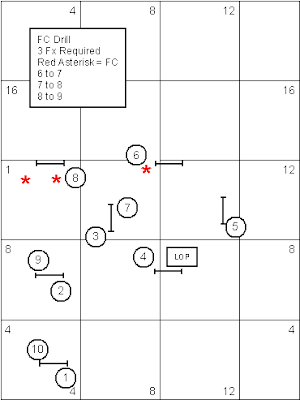 What I left out was another diagram that showed the next step up from this one. Initially we were all worried about cracked kneecaps and injured dogs when Greg first put this up.

As you can see the handler really has to move it from the #6 obstacle to well past #8 in order to pull this off. How well it was done depended on how much you had to babysit your dog over #7. However I am glad to report that there were no collisions , perhaps a few near misses but in the end just about everyone achieved it without too much trouble. Our biggest issues was that we were thinking about getting to #8 before ensuring our dogs had committed to #7. It was a very fine line to judge!
So that is the conclusion of this series on Greg Derrett's training seminars. There was an enormous amount to take in and I certainly will be going back to these notes time and again no doubt, for many of my training needs. It will be fascinating to see his next DVD and I look forward to his long term project one day; that of taking his young pup Detox all the way from 8 weeks old to what he hopes, will be a future World Champion. Any questions, suggestions, comments or feedback greatly appreciated, it may be a long time now till our next presenter!


 Spryte likes to use her pointy end in playing.