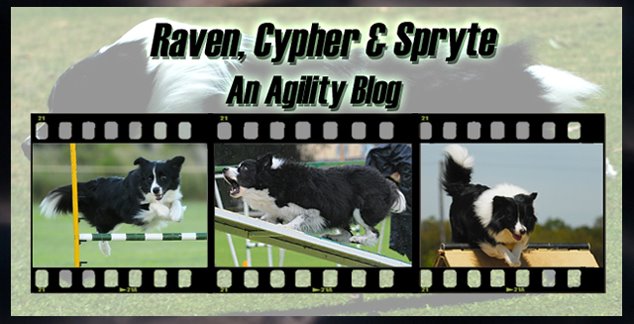
Ok had a few queries about Cypher's dogwalk contact - here is a video of it.
http://www.yourdogphotos.com/cy4onfloor.wmv
As you can see when he is going at full speed he ends up with his front legs tucked right under him. This is the only drawback to this behaviour and why eventually I will transfer it to a running contact.
Showing posts with label contacts. Show all posts
Showing posts with label contacts. Show all posts
Wednesday, April 18, 2007
Cypher's Dogwalk...4 on the Floor

Sunday, April 01, 2007
Dogs' Perspective Part 2
Just realised after a comment left on my last post that I didn't finish the photo below, I left the other end of the seesaw contact uncoloured and therefore not a true representation of the seesaw. So here is the photo version 2. Is this picture different enough? Maybe I should have another play with this photo and paint some yellow slats onto the dogwalk...it will be interesting if a couple of clubs in WA have a trial of the painted slats solution to see if that works.
Dogs' Perspective
The photo below was taken this morning of a friend's backyard equipment. It is the seesaw and dogwalk side by side taken from the angle of the dog's eye level as it comes out of a tunnel. Now my friend wisely elected to have her dogwalk and seesaw contact areas painted in different colours (the dogwalk has a blue contact area and the seesaw has a yellow contact area). However I have altered this photo so that it looks like what dogs see in trials where both the dogwalk and the seesaw are painted in identical colours. If you took away all the background info you have (seesaw legs don't usually protrude to the side on our trialling seesaws, you can see the dark underside of the dogwalk down ramp etc) as these are details that dogs would not see due to the fact that they are (or should be!) focusing on the up plank; and just tried to really picture it at a dog's view not even going terribly fast; say 2 to 3 meters per second I think you can imagine why some dogs are going up planks thinking they are seesaws when they are dogwalks and vice versa.
Friday, March 30, 2007
The Dog Walk Debacle
It really is tedious sometimes, attempting to elicit a straight answer from debates on email lists. When the issue of the slats being removed came up at the last ANKC rules review I really had no feelings one way or the other. I figured if they were off or on, it really didn't matter to me. In 12 years of agility I had only heard of one toe injury that could be proved beyond doubt, that it was caused by hitting a slat in an ugly way. Needless to say none of us here in WA really had a lot of information on this, however, there was a strongly voiced minority who had heard that this rule change to remove slats in the USA had gone horribly wrong and that the slats were replaced fairly rapidly. Yet there were those that were strongly voiced to get rid of them. The travesty that is the ANKC voting system is that it does not use the 'one state one vote' system which means WA's vote counts for one whereas a state like Victoria or NSW counts for two. Seems unfair to me but that's what we've got. So the slats/cleats came off completely. A rather pain in the arse job to do but it got done. Anyway to cut a long drawn out debate short it has been noticed (and still noticed over a year on now) that dogs are mistaking the seesaw for the dog walk and vice versa. Personally I don't have an issue with it. Slats off the dog walk meant Raven sometimes 'slid' into the contact position, it didn't concern me as she quickly figured out how much braking she needed to do. What I did see and still do see is previously rock solid dogs who ran confidently up the dog walk now come to almost a complete halt as they hug the up plank virtually crawling thinking the plank is a seesaw. I also see dogs that had well trained and well proofed seesaws do hair raising fly offs off the end of the seesaw as they think they were on a dog walk. It happens fairly often, often enough for me to notice. I really think that the touch and visual picture of the slats gave some of our fast dogs a clue as to what they were climbing. I cannot find one other major agility organisation that does not have slats/cleats on their dog walks. IFCS, USDAA, AKC, KC, UKA, NZKC, FCI, CPE; they all have slats on their dogwalk. This to me says something.
So I want to train for fast dog walks. Raven has been known to do sub 1.6 second dog walks in trials, but apparently according to some suggestions from the lists I am on, to have a dog moving at that sort of speed across a dog walk is apparently unsafe and irresponsible. That I should slow my dog down. I had hoped Australia had moved on from this kind of regressive thinking but I see that it is still alive and well in some quarters. Literally hundreds of top level competitive dogs from around the world can train the dog walks to be around 1.5 to 1.6 second mark. This is unsafe according to these thinkers, they believe they see dogs coming off because handlers are pushing for speed. Handlers cannot push for that type of speed, handlers learn how to train a dog who has that innate drive to move at that speed naturally. Dogs do come off when handlers do not set the line nicely onto the up plank or when handlers have not trained their dog to independently set their own line when starting the dog walk. It's quite frustrating to read these types of statements such as "handlers do not need to have 1.4 second dog walks". Of course we don't 'need' them if we don't have any inclination to be competitive at all but then why acknowledge first, second or third place? It's called 'Let's settle for just enough to get us round a course and under time'. Agility is so much more than this. Like I've said before I have no issues at all with handlers who want to look at it like this, in fact I encourage them because we need them to keep our sport healthy, but by the same token those of that ilk should not presume to tell those of us who wish to aspire to achieve better in our chosen sport that we are being unsafe in doing so. First and foremost these dogs are our family and we take just as much care as anyone else in the sport to ensure their safety. It is a game we play; but we all know when we take up the sport that we will be exposing our dogs to more risks than your average stay at home pet dog. The enjoyment that our dogs and ourselves get out of it obviously makes it all worthwhile.
Sunday, March 18, 2007
Cool website
After rereading my post about Greg's thoughts on contacts I went and looked up Silvia Trkman's site again. I discovered she has uploaded quite a number of videos since the last time I visited and I was thoroughly entertained and mesmerised by them all. Especially the one of her 11 month old Border Collie Bu doing repeated perfect running contacts. This dog is 54.5cm at the shoulder and the fact that Silvia has got this kind consistency already with a large dog proves to me that running contacts are possible. It has inspired me to want to retrain Cypher's contacts (after the Nationals mind you!) and to start doing small sessions with a down plank everyday with Spryte. Spryte has been over a full dogwalk and a lowered aframe already with me doing nothing except running with her encouraging her to run through the bottom by throwing a well placed treat. Which is what Silvia describes but just that with the dogwalk it should be on a flat plank initially maybe very slightly raised. I've decided I need a longer plank! Off to Bunnings today! Also inspiring were the videos of tricks that she teaches, it's fairly obvious why she doesn't have bar issues, her dogs are very aware of their two back feet! Her article about Agility is Good for dogs is also interesting reading. And if anyone can translate Slovenian I'd love to read her training articles for a Slovenian magazine!
Friday, March 16, 2007
Greg Derrett...Chapter 4
Contacts! So this session was always going to be interesting to find out Greg's method for his contact training. Before he started in on it he tested all of us who had working spots to see what we were doing. There were 12 of us again and most of us had a form of two on two off, some forms more precise than others. I was the only one who had the four on the floor method with Cypher (he runs through the contact and lies down with chin touching the ground). We started with the dogwalk, moved to the A Frame and finished with the seesaw. Greg put the stopwatch on all of us initially and we just ran our contacts like we would normally do in a trial. After timing us and calling the times out he then put in place several "proofing" type tests. The first one being you could only run halfway parallel with the dogwalk and your dog had to complete the contact. I think three of us managed this one, Cypher, Sage (who does two on two off) and one other, the next test was to peel off to the left of the dogwalk so laterally you were at least 12 meters away by the time the dog hit the contact. Again Cypher and Sage managed this along with 3 or 4 others this time. The next test was that you charged straight past the dog once it hit its contact position and the dog had to hold it. Next up was the A Frame and this time the last test was slightly different, you had to run past the a frame, if your dog held it's position you went back and rewarded, then you moved away again without releasing the dog, you had to face away from your dog, have your hands clasped in front of you (this is about 5 meters away) head facing forward. You had to give your release word. This was interesting as it tested how well we had taught our release words. I think only 2 of us managed to get our dogs to release on our release word. The next obstacle was the seesaw and there was no proofing tests on this one he just simply timed how long it took our dogs to complete it.
Greg then had us all move back to the whiteboard so he could go through his method in detail. He started off by stating that the two biggest mistakes people make with their contact training is that they don’t do the Foundation work properly, and that they go into competition too early. He basically said point blank that he wouldn’t be trialling with any of those dogs he saw tonight apart from one (that was Sage who does two on two off and is close to the top level times). He went through the list of things he was seeing that he would fix – dogs not understanding what the actual two on two off position was, dogs relying on body cues entirely, dogs not being reinforced properly, dogs not understanding the release word, dogs offering other behaviours, dogs not sticking to the same criteria and handlers letting them not stick to the criteria. The only comment he made about the four on the floor one that Cypher did was that he felt it was still not clear exactly where he is supposed to lie down. He was lying real close to the ends of contacts in some points, in others he was further away. I must admit I’ve never demanded that he must lie down 0.5 of a meter away from the contact every time because I believe that it depends on what speed he is going at as to what he feels comfortable doing. Generally Cy will lie down anywhere from half a meter up to 4 or 5 meters away from the contact depending on how flat out he is going and what obstacles are in front of him. Either way I’m happy with it because it means he’s missed one dogwalk contact in his entire trialling career so far. As I’ve said earlier, the system dictates the training, far more importance is placed on accuracy in our current agility climate than on speed simply due to the limited population we have competing. Will I train four on the floor again? I don’t think so. I came into four on the floor by accident really; when I was training his a frame getting that two on two off contact at full height was creating a lot of issues with impacting on his front; he tries to do the frame as fast as he can and getting his body into that two on two off position was putting a heap of visible stress on his body, he did hand stands trying to stick it and all sorts of other weird and not so wonderful things with his spine. We worked with it lower for ages moving it up inch by inch so that he learnt to rock his weight back, which worked up to a certain height (this dog is a tug-aholic so he knows how to shift his weight to his rear very well) and then at full height it just didn’t work with him running flat out over it. He was fine if we did a standing start on the upside, his momentum was slow enough for him to manage two on two off. So in the end I trained for four on the floor which kept his speed over it but didn’t tax his joints so much. I’m still not a fan of it though for all its accuracy, he will still, if hitting the frame at max speed, end up lying on the ground with his front legs sometimes tucked or folded under him because he’s done it in such a rush. It’s been known as the SPLAT! contact method as well and I also doubt that it is faster or as fast as a quick release two on two off.
Back to Greg, in his run down of the methods Greg mentioned that it doesn’t matter what you choose to train as long as it has the following four things: 1) Clear criteria 2) High Reinforcement when criteria is met 3) Must be able to be independent 4) Should use a verbal release. Obviously this last one completely eliminates the “running contact” from list of possible methods to teach! As far as Greg was concerned after travelling all over the world and competing against all types of dogs and trainers from many different countries he is still of the opinion that there is no reliable, foolproof method for training and *maintaining* a running contact. All those brilliant running contacts we see on the Worlds and other big events are more often just fast releases of 2o2o or if they are running contacts there is no discernible method that he could see when these teams were warming up or training. Sylvia Trkman’s Simply The Best is the most consistent running contact performer as far as he’d seen but he was not confident that there was any kind of logical, rational method to that contact. So that was interesting! Greg teaches the Susan Garrett nose touch method. The main reason behind his decision to use this contact method was simply because he was very impressed when travelling round North America how quick the breeds that were not your typical agility breeds were doing their contacts and inevitably they’d used the nose touch method. He saw Dobes, Mastiffs, Rotties, Bernese , Danes really large dogs doing fast dogwalk times because of this method and he was impressed by that. Another reason was because the reinforcement level was so high for this method as well. Obviously this involves target training which evolves from the simple hand touch he taught the dogs as youngsters. He uses a 1 inch square (yes it was asked 1inch?? Yes it really is that small) clear piece of plastic. There are no verbals used at all (this is where he differs to Susan) so this is where he may use the clicker. He might hold the plastic to start off with if he needs to but then it will go on the ground pretty quick. Most dogs will tend to sit when targeting this plastic, he moves 360 degrees around the dog constantly rewarding every time that nose hits that target. By hitting the target he means he wants to see that nose wrinkle as it mashes into the target. The nose touch is crucial for giving that weight shift you need at the end of the contact. Once that dog is hitting that target on the ground with its nose constantly over and over in all situations then he will transfer the target to a set of stairs. Yes stairs. Our first thoughts were – where the hell do you find stairs of the right size and shape and amount? He told us they use the wooden packing pallets in the UK. They get a bunch of them and stack them up on each other until you have a podium like effect with four stairs going up on one side and four stairs going down on the other. He places the target so that the dog has to have its front two paws on the floor and its back two paws on the first step. The dogs head should be pointing down in such a way that its nose is poking through its front two legs to hit the target on the floor. He gradually back chains the dog moving forward into position, ie starts the dog on stair two on the down side so it takes one step to get into position, then he’ll move it back to stair three and then stair four so the dog is now at the top of the pallets and so on and so forth until the dog is climbing up and over the stairs and down the stairs into the position. Once the dog is consistently charging over the stairs and hitting the target with its nose and releasing to a game of tug he will then transfer the target to a down plank. He sets the target so that the stop point for the dog is always the same, he demands of his dogs that they stop with their front feet just off, stopper pads in touch with the wood. The down plank will be worked for 6 to 7 weeks and then he moves straight to the complete dogwalk. He will play tug with the dog in position on the down plank as well as it helps give duration and weight shifting. And that is the way Greg trains his contacts. He also said that he will travel all over for the opportunity to run in trial situations and just reward the contact behaviour (ie dog does perfect contact position in middle of run Greg says thanks very much and runs out to play tug with dog) and that the only quick releases he does are at the two or three big events he does each year. This he did admit would be quite demotivating for your average trialler, even for many competitive triallers; to drive all that way, to enter a trial and simply go in the ring to reward that contact behaviour, he claims that it is what you have to do if you want to be the best in the world. Who knows? This could be quite true, I can’t say I’ve interviewed enough gold or silver world championship medallists to find out if this what they do all year round. It would be pretty darn disappointing for me I think if this is what I had to do all year round. It is hard enough for me to stick to my one criteria of a bar being knocked we leave, and at least that means I can’t qualify anyway! For me to pull Raven (the 7 yr old who does running contacts in trials; 2on2off in training) out of a run just because she doesn’t hold a two on two off would be just too against the grain for me, especially if she has just executed an amazing running contact. Usually if she misses it in a trial I’ll just stop her and put her back on and ask her to hold the position for a few seconds. I say usually because I do it based on the judges call, if she gets called for it I’ll put her back, if she doesn’t and I still think she may have missed it I don’t say anything funnily enough! This is all incredibly inconsistent I know but as a general rule it works for me. As long as I maintain the two on two off criteria in training and make sure I do enough repetitions during the weeks between trials and highly reward that position (and I mean highly…I don’t just stuff one or two treats down her, she will get rewarded with up to ten or twelve small treats for one great two on two off in training…it keeps her in the spot for quite a while and always with her thinking this is the greatest spot in the world to get to!) I tend to find they hold up. It’s probably just this sort of thing Greg was talking about when he says he doesn’t believe there is a real, reliable and consistent method for teaching running contacts. I’m inclined at this stage to agree but that doesn’t mean I still can’t have them at trials!
With the A Frame Greg teaches it after the dogwalk or around the same time (so that targeting stuff is all there already) and basically just starts the a frame at 12 inches high and gradually raises it up. Nothing too secret or mysterious there. Now the seesaw. That one shocked me I must admit. Greg’s criteria on the seesaw is that the dog must run to the end of the seesaw hang its two front paws off the end and ride it down whilst trying to nose touch. I had visions of what might happen to some of our really fast dogs if we insisted on that sort of criteria and they were scary! They start with just a normal sized seesaw at full height and then they stack up the pallets again until they sit right underneath the end of the down side of the seesaw so that it can’t move at all. They get the dogs to run to the end and nose touch onto the pallets. Slowly they remove the pallets, very gradually so the seesaw only moves a few inches initially. And that’s how they work it, eventually all the pallets are removed (this can take many weeks or months I’d imagine) and the seesaw is slamming down at full height. The dog is still offering the nose touch all the time. He did mention that it was important that all seesaws are made to the same specs, so the tipping point and weight are all the same from one to the next. We don’t have that here in Australia yet which is another reason why I would shy away from using this method. We also don’t have a clear way for the dogs to always discern if it is a seesaw or dogwalk (no slats) they’re climbing and they do rely on us using verbals. The main reason is why i wouldn’t lean towards this method; that I can see; is accidents with noses mashing into the ground too hard, toes getting stuck under the ends, wrist joints being unduly impacted upon, neck issues etc etc. As far as I can see there is no reason to go fiddling with what most fast dogs do here which is run nearly to the end, ride it down (most commonly in the dropped or half dropped position) and take off when it hits the ground. Our seesaw times are competitive so not sure I’d mess with the seesaw training just yet. So that’s about it for contacts. I should have asked about the chin touch target training, I think the biggest complaint he would’ve had about that would be that you don’t always know if the dogs’ actual chin is hitting the target. Cypher very easily placed his chin on the target and you could see it because he rested his head as opposed to his head slightly raised which you could also detect pretty quick. The nose touch to me seems quite a risky behaviour to teach especially to the high drive, really intense BCs that often do stuff without regard at all to their own self preservation, these are dogs that will run courses with toe nails ripped half off, or severe ligament injuries or even if they suffered from acute pain if we don’t stop them. It makes me think that running flat out to a spot so they can mash their nose into the ground over and over may not be the best plan…Susan Garrett had to change her tack with Buzz because he used to give himself nose bleeds in his full on bid to do as she asked. Nobody has really taught it or insisted on it here to the extent that you will be able to easily say ok that dog uses the nose touch method when you see it compete. I think some people have taught it but have lessened off the criteria to the point where you just see the head duck down repeatedly as though they are going to nose touch. I will remain open minded about this and I hope to maybe see some well trained nose touch methods at the Nationals this year. The weaves will have to wait for my next entry! Along with his jumping thoughts.
Subscribe to:
Posts (Atom)